


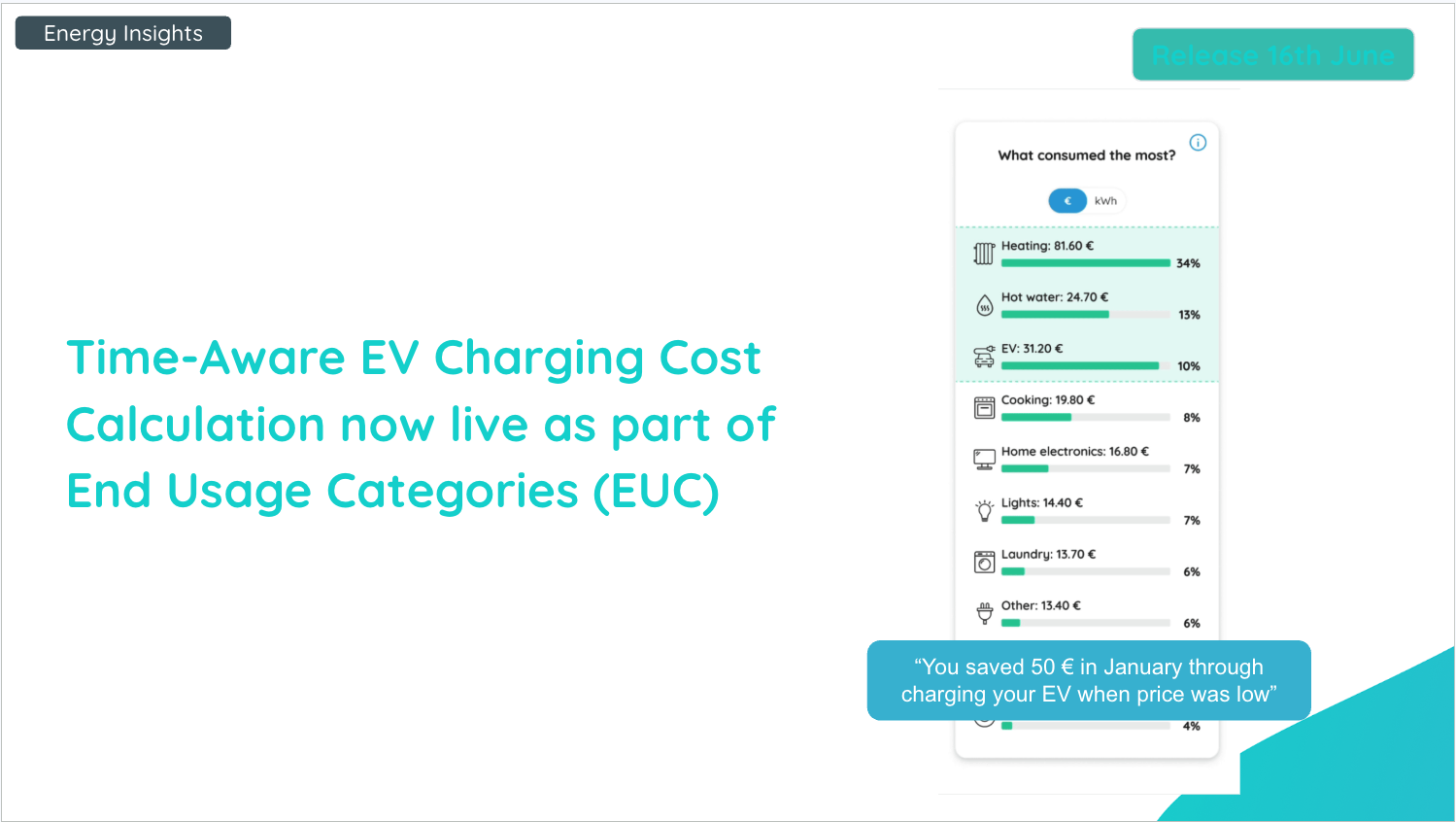
Time-Aware EV Charging Cost Calculation now live as part of End Usage Categories (EUC)
EV category in EUC now take the time for charging into account when calculating costs.
New interface design
Lorem ipsum dolor sit amet, consectetur adipiscing elit lobortis arcu enim urna adipiscing praesent velit viverra sit semper lorem eu cursus vel hendrerit elementum morbi curabitur etiam nibh justo, lorem aliquet donec sed sit mi dignissim at ante massa mattis.
- Neque sodales ut etiam sit amet nisl purus non tellus orci ac auctor
- Adipiscing elit ut aliquam purus sit amet viverra suspendisse potent
- Mauris commodo quis imperdiet massa tincidunt nunc pulvinar
- Excepteur sint occaecat cupidatat non proident sunt in culpa qui officia
New notifications panel
Nulla euismod lacus vitae vulputate elit tellus iaculis elit donec nunc consequat cursus vestibulum in in et sit auctor neque semper libero nunc bibendum porttitor fusce fringilla malesuada est in feugiat cursus gravida auctor tempor facilisi ut id vel arcu nibh sem pellentesque id ornare volutpat nisi tristique mattis.
New team members management
At risus viverra adipiscing at in tellus integer feugiat nisl pretium fusce id velit ut tortor sagittis orci a scelerisque purus semper eget at lectus urna duis convallis porta nibh venenatis cras sed felis eget neque laoreet suspendisse interdum consectetur libero id faucibus nisl donec pretium vulputate sapien nec.
- Neque sodales ut etiam sit amet nisl purus non tellus orci ac auctor
- Adipiscing elit ut aliquam purus sit amet viverra suspendisse potenti
- Mauris commodo quis imperdiet massa tincidunt nunc pulvinar
- Adipiscing elit ut aliquam purus sit amet viverra suspendisse potenti
New API access
Nisi quis eleifend quam adipiscing vitae aliquet bibendum enim facilisis gravida neque euismod in pellentesque massa placera diam donec adipiscing tristique risus amet est placerat in egestas erat.
New API requests
Eget lorem dolor sed viverra ipsum nunc aliquet bibendum felis donec et odio pellentesque diam volutpat commodo sed egestas aliquam sem fringilla ut morbi tincidunt augue interdum velit euismod eu tincidunt tortor aliquam nulla facilisi aenean sed adipiscing diam donec adipiscing ut lectus arcu bibendum at varius vel pharetra nibh venenatis cra.
What's changing
EV drivers on spot price or static time-of-use tariffs often charge at off-peak hours specifically to save money — but until now, the Energy Use Breakdown (EUC) didn't reflect those savings. EV costs were calculated by applying the EV share of total energy (kWh) proportionally to the total bill, meaning a user who charged entirely at night at cheap rates would still appear to pay the same cost share as their energy share suggested.
With this release, EV charging costs are calculated based on when the charging actually occurred. If a user charges at cheap off-peak hours, their EV cost in the breakdown will reflect that — it can now represent a meaningfully smaller share of total cost than it does of total consumption.
Example: A user's EV accounts for 20% of total energy consumption (kWh), but because they charged primarily at low-cost overnight rates, EV charging represents only 10% of their total electricity cost. Both figures are now correctly surfaced in the breakdown.
Client requirements
For time-aware EV cost calculation to activate, all three of the following must be in place:
- Price formula with a Time of Use tariff (static or dynamic including spot price) on the electricity import meter
- Home profile property electric_cars set (produces the EV category in the breakdown)
- Energy Data resolution: 15-minute, 30-minute, or 1-hour intervals
Fallback behavior
If any of the above requirements are not met, the system falls back to the previous behavior: the total monetary value is distributed across all categories (including EV) proportionally by each category's share of total energy consumption (kWh). No configuration is needed — the fallback is automatic.
What you need to do
If all three requirements above are already in place: nothing. The improved EV cost calculation activates automatically when the EUC endpoint is called with unit=cost. To retrieve EUC data in costs, call:
GET /v3/locations/{locationId}/euc?unit=cost
The electric_vehicle category in the response will now reflect the time-aware cost rather than the energy-proportional estimate.
For full API reference, see the EUC endpoint documentation.
Value for end users
- Accurate cost reflection: Users who actively manage when they charge will see their cost savings in the app, reinforcing the benefit of smart charging behavior.
- More trustworthy breakdowns: Cost and energy shares can now diverge meaningfully, giving a more honest picture of how dynamic pricing affects the bill.
- No action needed from users: The improvement is automatic for any user whose account meets the requirements above.