


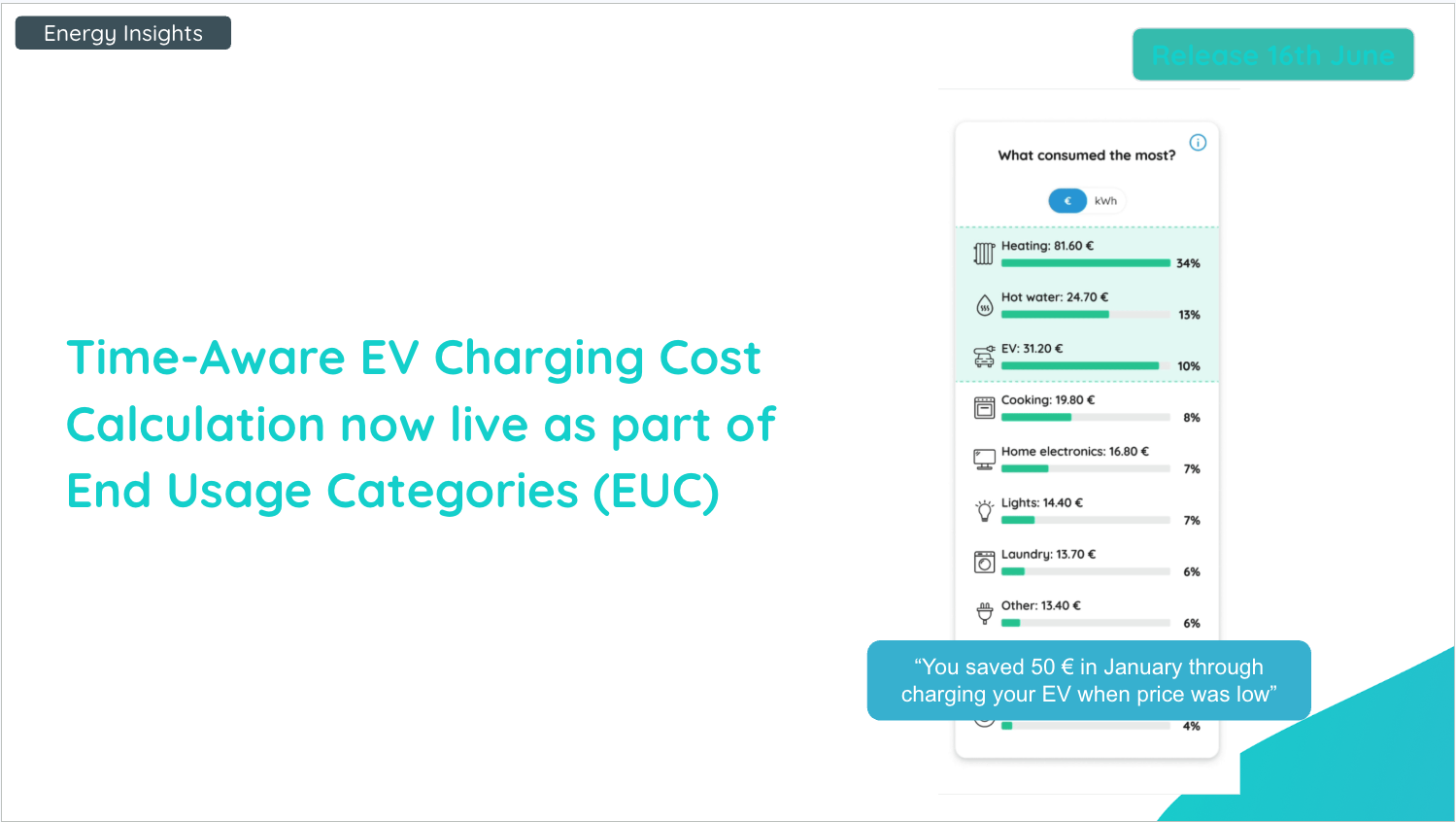
Time-Aware EV Charging Cost Calculation now live as part of End Usage Categories (EUC)
EV category in EUC now take the time for charging into account when calculating costs.
What's changing
EV drivers on spot price or static time-of-use tariffs often charge at off-peak hours specifically to save money — but until now, the Energy Use Breakdown (EUC) didn't reflect those savings. EV costs were calculated by applying the EV share of total energy (kWh) proportionally to the total bill, meaning a user who charged entirely at night at cheap rates would still appear to pay the same cost share as their energy share suggested.
With this release, EV charging costs are calculated based on when the charging actually occurred. If a user charges at cheap off-peak hours, their EV cost in the breakdown will reflect that — it can now represent a meaningfully smaller share of total cost than it does of total consumption.
Example: A user's EV accounts for 20% of total energy consumption (kWh), but because they charged primarily at low-cost overnight rates, EV charging represents only 10% of their total electricity cost. Both figures are now correctly surfaced in the breakdown.
Client requirements
For time-aware EV cost calculation to activate, all three of the following must be in place:
- Price formula with a Time of Use tariff (static or dynamic including spot price) on the electricity import meter
- Home profile property electric_cars set (produces the EV category in the breakdown)
- Energy Data resolution: 15-minute, 30-minute, or 1-hour intervals
Fallback behavior
If any of the above requirements are not met, the system falls back to the previous behavior: the total monetary value is distributed across all categories (including EV) proportionally by each category's share of total energy consumption (kWh). No configuration is needed — the fallback is automatic.
What you need to do
If all three requirements above are already in place: nothing. The improved EV cost calculation activates automatically when the EUC endpoint is called with unit=cost. To retrieve EUC data in costs, call:
GET /v3/locations/{locationId}/euc?unit=cost
The electric_vehicle category in the response will now reflect the time-aware cost rather than the energy-proportional estimate.
For full API reference, see the EUC endpoint documentation.
Value for end users
- Accurate cost reflection: Users who actively manage when they charge will see their cost savings in the app, reinforcing the benefit of smart charging behavior.
- More trustworthy breakdowns: Cost and energy shares can now diverge meaningfully, giving a more honest picture of how dynamic pricing affects the bill.
- No action needed from users: The improvement is automatic for any user whose account meets the requirements above.